
Does Art Make Free?
A Jewess in Poland, Day One

Join the free 21 Day Dig, starting May 21! Daily live prompts and journaling with me, 9am ET. Free and open to all subscribers (free and paid)!
I still get surprised that you can hold a place in your mind for years, then get on a plane and it’s there. Like Poland, in particular Krakow, the ground from which I type yet did not visit during the decade I spent writing a play set in these square meters.
The Lucky Star is a true story based on letters from a well-to-do Jewish family, the Hollanders, who mostly didn’t leave Poland in 1939 when they had the chance, figuring life would get back to normal (a normal that I now understand to be a millennium-long balancing act, predictable precarity within a country seized and divided, then independent in 1918, with relative tolerance or persecution cycling with conquest, or whim). The nine members of the Hollander family wrote hundreds of letters to the youngest son who did leave, hoping he would deploy his (nonexistent, but who knows what he said in his letters) wealth and status in America to help them beat crushing odds. (He nearly, heartbreakingly, succeeded, securing visas to Nicaragua a month after the Nazi government sealed the borders.) Their letters chart the terrifying, constricting four years under Nazi occupation, then cease in 1943, when the Krakow Ghetto was “liquidated,” meaning its inhabitants were shipped to death camps or shot in the square.1
My husband Todd and I came for a festival, a theater gathering. But I really came to keep an overdue date with the Hollanders’ history and my artistic experience, to stand in that square, to walk the Jewish quarter of Kasimierz, where the Hollander family did not live, instead embracing permission to make their Jewish home anywhere they wanted, choosing a swank apartment by the Dzikie Gardens. I wanted to see the apartment, and Jagellonian University where Joseph Hollander received a law degree, standing in the back because Jewish students were not permitted to sit, but could, in small quotas, study and practice the law.
I decided we would would backwards, starting with the ghetto (which Joseph’s sister innocently explains will be located not in the Jewish quarter, but in Podgórze, “near the railroad tracks”). The Krakow Ghetto was just a half an hour’s walk from our hotel, so we could start there, look around, and make it to the Jewish quarter for lunch.
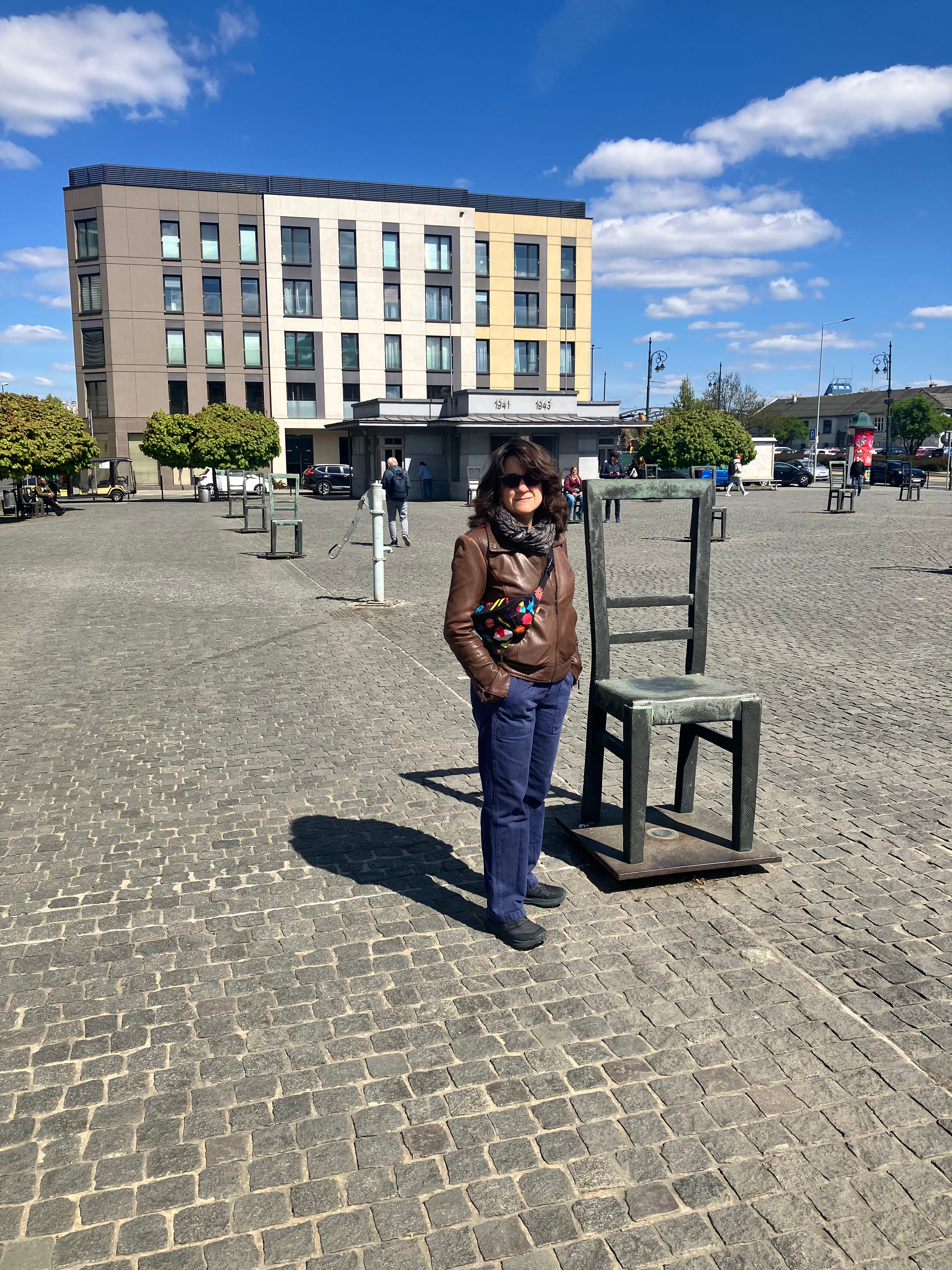
So we walked to the site of the ghetto, now a memorial with metal chairs because the Polish Christian pharmacist Tadeusz Pankiewicz (who, finding his business located within the borders of the ghetto, chose to stay and serve the people) recalled furniture hurled from Jewish homes. (Pankiewicz is mentioned in the Hollander letters and appears in Schindler’s List, which takes place right here in Krakow). We paced the rooms of the Eagle Pharmacy, which was nationalized under Communism, then became a bar, then remade in 2003 as an eerie, satisfyingly tactile museum with cupboards to open, drawers of photographs to handle, herbal compounds to smell, and a phone you can pick up to hear first-person accounts of folks being beaten, sorted, and shot.
There’s still a train at Podgórze, a tram that zips north over the River Vistula, stopping first at Kazimierz, which is no longer a Jewish quarter because there are virtually no more Jews in Poland. But you don’t need a tram; the walk is short, a few hundred steps across a foot bridge.
Kazimierz is now a hipster nightlife spot, with craft vodka bars spilling out from under Yiddish-lettered signs and a concept restaurant called Hevre (friendship) in an “old synagogue,” which did not feel that old, more like a place where people prayed and married until 1941, when they would have been sent over that footbridge, to that ghetto, Orthodox crammed against more secular folks like the Hollanders. The streets feel a bit like Williamsburg, Brooklyn, but instead of old and new living side by side, the new (including us) eat, drink, and dance in the funky intage haunts, while the old are gone gone gone. We nabbed the last spot at Hevre, but I found it hard to eat.
We found the Hollander address still standing, under scaffolding, and to my surprise, less than a ten-minute walk from the Jewish quarter. All of the locations in the correspondence, places that seemed worlds apart, are walkable. Even the labor-then-concentration camp at Plaszów where the youngest sister follows her husband, agonized to be separated from her family perhaps forever (and it probably was forever) is one more ten-minute walk past the ghetto, a walk I did not take. No one had traveled as far as they thought. Not in any sense.
That same first day, I got fitted for a bra because my fashionista friend told me Polish bras are the best (true!), ate more goopy food, steamed and saunaed at our “art deco” hotel, watched a two-hour play in Polish, and fought with my husband who, like the wicked child at the Passover Seder, asked what I was feeling and got to hear not what I was feeling but what he too should be feeling, even though he did not write a play about Krakow, nor learn Yiddish in his twenties, nor does he possess a sporadic Jewish identity that might abide passively for months, then burst into downpour, like a Polish spring.
Why did I think I could visit Poland like a tourist? Maybe because my people aren’t from here (which according to the Polin Museum of Jewish History in Warsaw, puts me in the minority: 70% of Jews worldwide have at least one ancestral tie to Poland). My grandparents were born in Ukraine (two), Romania, and Iowa (also Russian but further back). Polish Jewish history ripened and grew thanks to King Kazimierz, “the one good king” (overheard from a tour guide), who in 1334 straight up invited Jewish people to come live in Poland with full equal protections. (Our driver to a respite day at a medieval salt mine opined that King K owed his expansive politics to love for a Jewish woman.) By 1939, Jews formed about 10% of the Polish population, much more in cities like Krakow, and about half of Jewish people worldwide lived in Poland (also according to the Polin Museum). So if you are a proud Diaspora Jew as I am, your vision is tied to Poland, a millennium-long rich, varied, spiritual, cultural Jewish legacy that wound up dead.
Or so I explained to my husband as I tried to sleep, before dreaming that writing this essay would betray someone in hiding, so I shouldn’t post anything at all. Ancestral trauma as procrastination.
Yet here’s the best part of Day One:
Early in the day, we tried to visit the Schindler Factory (also rebuilt and re-opened in 2010, a theme I’m connecting to capitalism), but the line was too long and not moving, and we had that lunch reservation, so we detoured to MOCAK, the Museum of Contemporary Art in Krakow (also built in part of the Schindler Factory), which turned out to be holding the largest solo retrospective of a female artist I’ve ever seen, Ewa Partum (b. 1945), work spanning from the 1960s until the 2010s, video, sculptural, public performance, and more. Partum’s work headlines a museum full of women artists, people who made art under Soviet domination in a persistently patriarchal society (Poland maintains a near-total ban on abortion, the most draconian in Europe), women who saw the worst, forerunners and contemporaries of people I knew better like Marina Abromovic, artists who made massive, mysterious work that leads without knowing where it’s going.
Here’s Eva Partum’s sculpture Concert With Hair (1983):
And here’s Valie Export’s debut video Challenging Experiments on Self and Others (1966), in which she takes a camera her sister gave her as a gift and mugs a stone statue, imitating an imitation of a girl:
This too is Poland.
A huge wall in MOCAK boasts a work by Grzegorz Klaman, Kunst Macht Frei, barbed wire out of lights, of course a riff on Auschwitz, Arbeit Macht Frei, (only 60 miles from here).
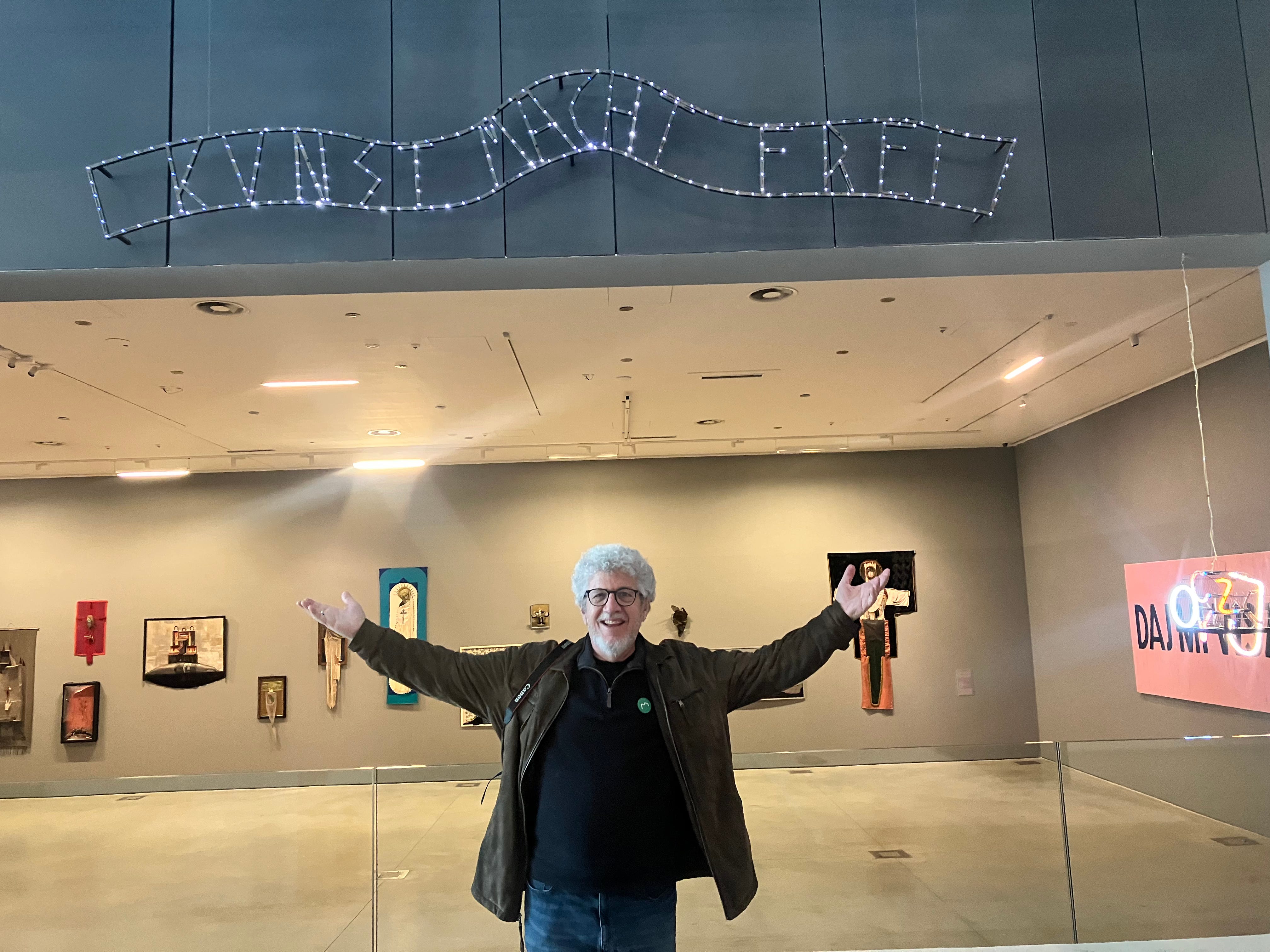
What are these artists doing with their history? What are any of us doing?
Does art make free? Yay or nay?
I’m still here, in every sense of the word, and I’m still curious.
More about the Museum of Contemporary Art in Krakow (MOCAK)
The Lucky Star by Karen Hartman
The Hundred Day Reckoning offers tools to transform your response to Life Drama, plus candid personal tales from my own reckonings, plus reflections and artwork from the magnificent alumni of The Hundred Day Reckoning Program.
Join the free 21 Day Dig, starting May 21! Daily live prompts and journaling with me, 9am ET. Free and open to all subscribers (free and paid)!
See you next Wednesday! - KH
Read more about The Lucky Star in A Dramatist’s Beef with Drama
Very nice and refreshing read. I'm born in Kraków (now living elsewhere) and I read your story for curiosity what would the reception of the town be, these days, from the standpoint of a foreign Jewish visitor. I'm glad your tour was positive, and also learned a lot.
Kraków is a good starting point, I think, because it's pleasant and has tourism infrastructure. If you ever come for a second time, I invite you do look beyond, and my advice (contrary to most people in Kraków) would be, definitely, Silesia, just an hour west. I wrote something on it. Stay well! https://nomadicmind.substack.com/p/silesia-the-other-poland